
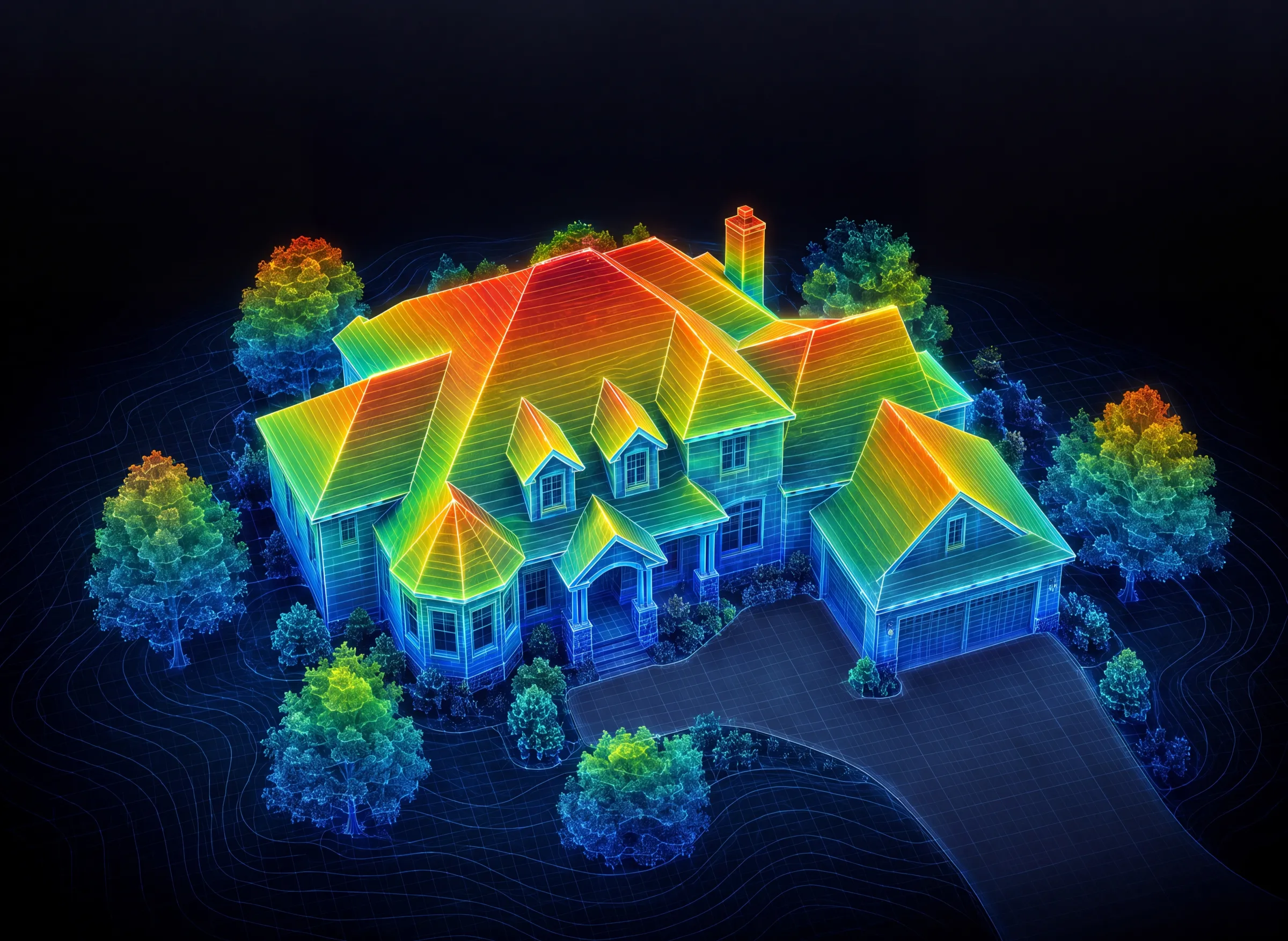
Kestrel was built inside a technology-forward roofing company in Denver, run on purpose to prove out new tools on real jobs. The measurements we could buy were never precise enough to carry a job from measurement to estimate to work order to material order with confidence. So we built our own. That became Kestrel, and it’s patent pending.
Why start a roofing company to build software?
Because you can’t fix a roofer’s problem from a conference room. In 2025 our founders ran a roofing company in Denver. It sold real jobs, sent real install crews and ordered real material, but it existed for a second reason: to test the tools we were building against the work itself. It was a technology company that happened to do roofing.
That meant every flaw in our tools landed on our own margin. Nothing teaches you faster.
What was wrong with the measurements we were buying?
The reports gave us lines and squares. What they never told us was how the roof was actually built.
An estimate needs more than area. It needs the pipe jacks and boots, the vents, how much ventilation the roof really needs, where the kickout flashing belongs even when it isn’t there yet. None of that came in the report. So every job needed a person in the middle, usually a production manager or a seasoned salesperson, translating a picture into a real scope. That person is expensive, hard to find, and can’t be at every kitchen table.
And the number itself was a question mark. It was traced from a photo taken far overhead, often long before we were ever called out, and nobody had checked it by hand. So we did what the whole trade does: padded the order and hoped.
No matter what we used, we couldn’t go from measurement to estimate to work order to material order with confidence. So we built Kestrel.
To be fair, the reports on the market and a tape measure on the roof still work. Plenty of good roofers run on them. We just wanted a number we could build a whole job on, without the guesswork in the middle.
Who had the idea?
Kestrel exists because of Cory Shelton. Cory spent years as an insurance adjuster, then went inside the estimating and geospatial-measurement software that much of the industry runs on. He saw the problem from both sides, the person holding the tape and the software drawing the lines, and he was convinced it could be done better: capture the roof up close, the day you’re there, and build the measurement from that.
Who built it?
Aaron Allen built the measurement workflow: the drawing tools, the 3D model work and the capture guide our customers’ teams use to fly a roof.
Jim Johnson has been chasing this problem for twenty years. Back in 2006 he built a tool that let you draw a roof with a pen on a touchscreen, pop every line to a clean drawing, then drag the accessories onto the roof and walk away with a full estimate and a material order for both the install crew and the supplier. It had about 1,500 users. Kestrel is the version of that idea he always wanted: one that starts from the real roof, not a drawing of it.
Why the name Kestrel?
A kestrel is a small falcon with a famous trick. It holds itself perfectly still in the wind, a few stories up, and studies the ground below in detail before it commits. Close, patient and precise is exactly how we wanted a roof measured. Not from miles away. Not from last year. From right there, today.
What happened to the roofing company?
It did its job. The tools worked well enough that we closed the roofing company to build full time. One of those tools became Bench, the operating system for contractors. The other became Kestrel. Today Kestrel is its own company and a sister company to Bench. You don’t need to run on Bench to buy Kestrel, but every Kestrel lives in a Bench login, where the same numbers carry through to the estimate, the material order and the work order.
What does Kestrel do, in one paragraph?
Your team captures the roof from a few stories up. Kestrel turns those photos into a 3D model of the roof as it stands that day and builds the measurement from it: every facet, every run, every penetration. Then that one source of truth puts a good, better, best estimate in front of the homeowner and, once they sign, generates the material order and the work order. Fifteen dollars a roof. From wow to work order.
What’s next?
Roofs are first. Siding, windows, trim, gutters, garage doors and door openings are coming soon, and after that pavement, landscaping, fence and any other measurement a house needs. Kestrel makes its first public showing at RCAT 2026, October 21–23 in Grapevine, Texas. If you’re there, come find us. If not, book a demo and we’ll show you a real roof.